
I write with disappointment at the minimal visibility of African affairs in the Australian newspapers I read weekly (online)—The Australian, the Australian Financial Review (AFR), and The Age—particularly when compared with other major News outlets in the Asia Pacific over the same period.
📊 6–14 December 2025 | Coverage Snapshot
• The Australian: ~4–5 Africa-related items (Sudan, South Africa, West Africa + sport)
• AFR: No verifiable, date-specific Africa articles
• The Age: Unable to reliably identify due to paywall/indexing restrictions
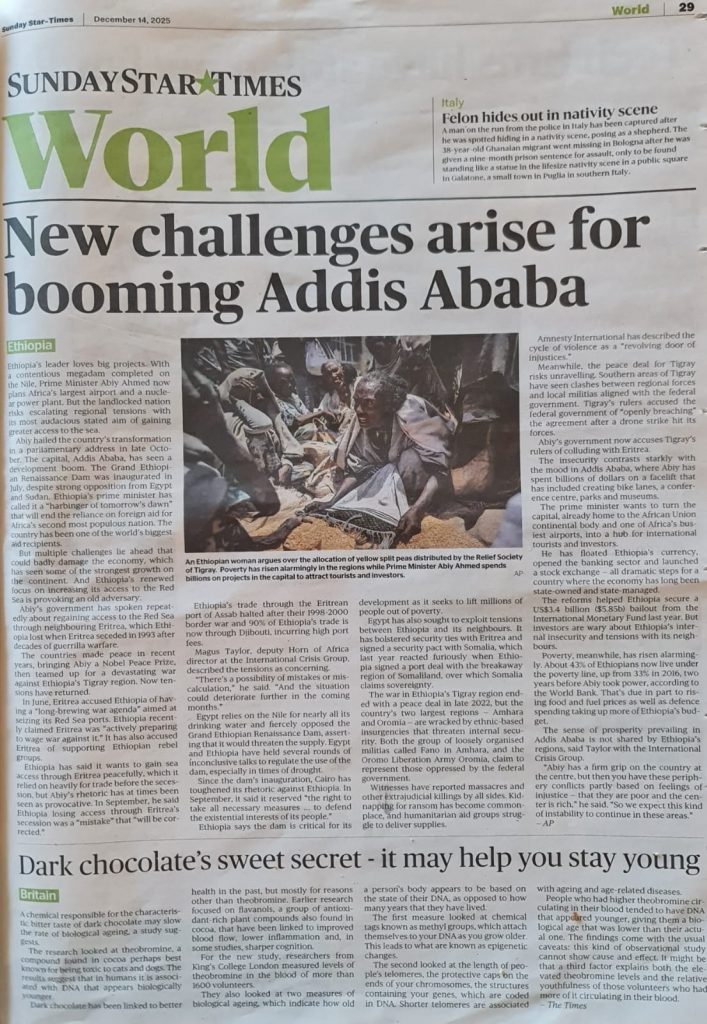
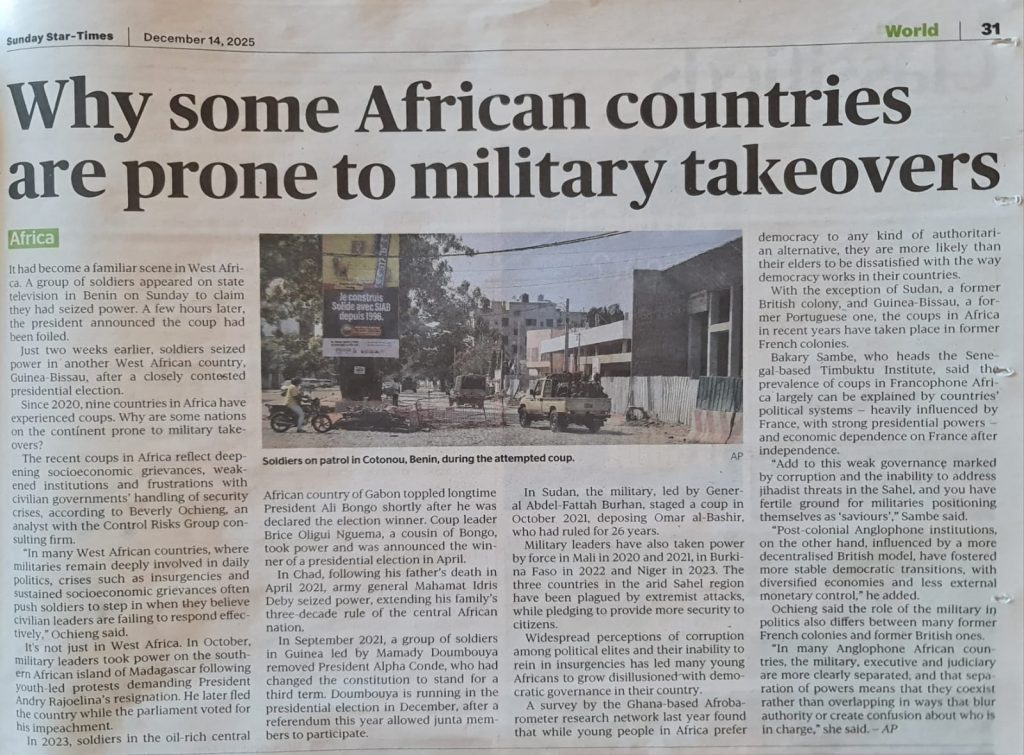
• New Zealand Herald: 2–3 clearly Africa-focused world-news stories
During the observed week (approximately 6–14 December 2025), publicly indexable material shows that The Australian carried around 4–5 Africa-related items, split between geopolitics (e.g. Sudan, South Africa, West Africa) and sport. AFR, despite maintaining a dedicated Africa section, yielded no verifiable, date-specific Africa articles accessible through public indexing in that period for writing this post. For The Age, Africa-related coverage could not be reliably identified at all due to paywall and indexing restrictions, which effectively render its international editorial priorities opaque to external scrutiny. However, I would like to point that all these newspapers can be accessed digitally as well as in paper format via public libraries. The State library is also a good resource.
By contrast, New Zealand within the same week, I read at least 2–3 clearly Africa-focused world-news stories, covering political events and global health and development finance. I think the New Zealand Herald alone seem to do a better coverage than almost all the Australian newspapers put together.
🌍 The Australasia Contrast
New Zealand (~5.3 million people) is markedly smaller than Australia (~27.5 million), and also further from major African hubs—Auckland–Johannesburg is roughly 7,575 miles, versus Sydney–Johannesburg at roughly 6,862 miles—yet New Zealand's major public outlet(s) appear to give Africa more routine visibility than Australian newspapers.
Two structural patterns are evident. First, paywall and access restrictions in Australian newspapers significantly limit transparency and comparative accountability. Second, where Africa does appear, coverage is disproportionately sport-mediated, particularly through South Africa, rather than through sustained political, economic, or social analysis. Sport dominates visibility, while substantive engagement remains scarce.
The issue, therefore, is not simply one of article counts, but of editorial framing and proportionality. New Zealand, Malaysia, China and Japan appear more willing to normalise Africa as part of the global present. Australian newspapers, by contrast, continue to marginalise the continent despite Africa's population of over 1.4 billion people and its growing geopolitical, economic, and diaspora relevance to Australia itself.
📰 Australian Media Landscape: A Brief Overview
Here is a brief overview of the Australian newspapers I read this week in summary:
First, economic pressure is foregrounded. Recurrent references to cost-of-living, wages, inflation, productivity, and fiscal restraint suggest a media environment responding to sustained public unease rather than episodic shocks. The repetition of similar economic framings across outlets indicates agenda convergence rather than pluralism—different mastheads, broadly the same macro-narrative.
Second, political leadership is framed defensively rather than aspirationally. Prime ministerial coverage appears reactive—focused on containment, explanation, or damage control rather than policy imagination. This reflects a mature but fatigued democratic cycle, where governance is narrated through crisis management rather than long-term vision.
Third, there is a compression of global and domestic concerns. International conflicts, geopolitical instability, and foreign policy tensions sit alongside local scandals and national debates, implying that the boundary between "foreign" and "domestic" news has effectively collapsed. Australia is portrayed not as an observer of global disorder, but as entangled within it.
Taken together, I read about an Australian society negotiating uncertainty, institutions under scrutiny, and a press attempting to remain authoritative amid structural change.
🌏 Asia-Pacific vs. Australia: Africa Coverage Compared
Across the Pacific, Africa is typically covered instrumentally through geopolitics, trade, security, and summit diplomacy rather than as a sustained, everyday news beat. China institutionalises Africa coverage through state-media pipelines; Japan's attention concentrates around strategic diplomacy and political economy; and Malaysia and Singapore tend to surface Africa when it intersects with bilateral initiatives, investment, or elite travel and commercial narratives.
✈️ Distance Comparison
• Sydney ↔ Johannesburg: ~6,862 miles
• Auckland ↔ Johannesburg: ~7,575 miles
Despite being further from Africa, New Zealand provides more routine Africa coverage than Australia.
This makes the Australasia contrast harder to ignore. New Zealand (~5.3 million people) is markedly smaller than Australia (~27.5 million), and also further from major African hubs—Auckland–Johannesburg is roughly 7,575 miles, versus Sydney–Johannesburg at roughly 6,862 miles—yet New Zealand's major public outlet(s) appear to give Africa more routine visibility than Australian newspapers. The pattern is compounded by two structural distortions: paywall/indexing opacity that limits accountability and comparability, and a persistent tendency for Africa to register primarily through sport, especially South Africa, rather than substantive political, economic, and social reporting.
The question remains: why does Australian media continue to marginalise a continent of 1.4 billion people with growing geopolitical and economic relevance—including direct diaspora ties to Australia itself? Paywall opacity, editorial priorities, and a persistent framing of Africa through sport rather than substantive analysis all contribute. But the deeper issue may be one of imaginative geography: Australia still looks primarily to Europe, North America, and Asia, while Africa remains peripheral in the national consciousness—despite its proximity in global affairs.
Comments and feedback, as always, are welcome.